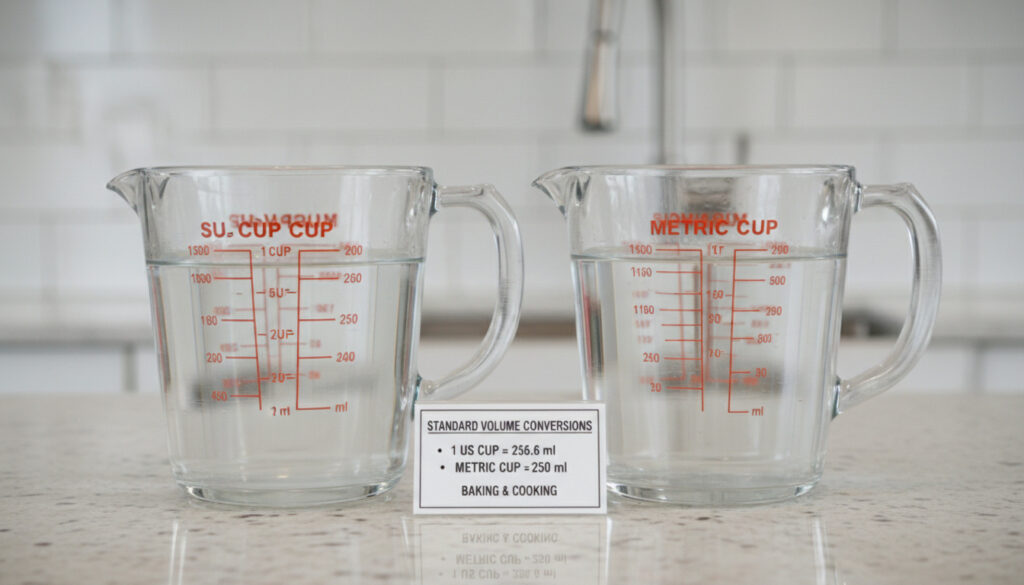
How Many mL in a Cup – US 236.6, Metric 250 Guide
One US customary cup equals exactly 236.588 milliliters, though 236.6 mL serves as the standard rounded figure for kitchen measurements. This conversion applies universally to liquid ingredients, providing a consistent baseline for recipes originating in the United States.
However, the answer shifts depending on geographical and historical contexts. A metric cup measures 250 mL, while the Imperial cup used in older UK contexts holds 284 mL. These variations trace back to 20th-century international treaties and regional adoptions of measurement standards.
Precision matters significantly in baking and international recipe adaptation. Understanding which standard a recipe references prevents proportion errors that could affect chemical reactions in baking or seasoning balances in cooking.
How Many mL in a Cup?
- The US customary cup is defined as precisely 236.5882365 mL, equal to 8 US fluid ounces.
- Regional variations arise from distinct historical measurement standards and treaty adoptions.
- Always verify whether a recipe uses US customary, metric, or Imperial standards before converting.
- One cup of water measures exactly 236.588 mL by volume, while dry ingredients like flour vary significantly by packing density.
- The US legal cup at 240 mL differs from the customary cup used in home cooking.
- Pre-1970s American recipes may reference the 284 mL Imperial cup.
- Canada and Commonwealth countries standardized on the 250 mL metric cup.
| Cup Measurement | Milliliters | Fluid Ounces | Common Usage |
|---|---|---|---|
| 1/4 cup | 59 mL | 2 fl oz | Small liquid measures |
| 1/3 cup | 79 mL | 2.7 fl oz | Partial cup divisions |
| 1/2 cup | 118 mL | 4 fl oz | Standard half measure |
| 2/3 cup | 158 mL | 5.3 fl oz | Baking proportions |
| 3/4 cup | 177 mL | 6 fl oz | Three-quarter measures |
| 1 US cup | 236.588 mL | 8 fl oz | US recipes |
| 1 Metric cup | 250 mL | 8.45 fl oz | International recipes |
| 1 Imperial cup | 284 mL | 9.6 fl oz | Traditional UK |
How Many mL in a US Cup?
The United States maintains two distinct cup definitions. The US customary cup measures 236.588 mL and serves as the standard for cooking and baking measurements. This definition derives from the US gallon, where one cup represents 1/16 of a gallon or 8 fluid ounces according to UnitToolbox.
Conversely, the US legal cup measures exactly 240 mL. Established by a 1970 international treaty, this standard appears primarily on nutrition labels and in commercial food packaging. The 3.4 mL difference between legal and customary cups rarely affects home cooking but becomes significant in precise nutritional calculations or large-scale food production.
Historical Adoption of Measurement Standards
Prior to the 1970 treaty standardization, American recipes occasionally referenced the Imperial cup at 284 mL. This larger measurement aligned with British Commonwealth standards before the United States formally distinguished its customary system. The Calculator Site notes that pre-1970s cookbooks may therefore contain proportionally different ingredient ratios than modern equivalents.
The 240 mL legal cup applies to nutrition facts panels and FDA-regulated packaging, while the 236.588 mL customary cup governs actual cooking measurements. For ingredients where precision matters—such as baking powder or yeast—verify which standard your measuring cups follow.
How to Convert Cups to mL?
Converting cups to milliliters requires multiplying the cup value by 236.588 for US measurements or 250 for metric standards. GigaCalculator provides that for technical conversions, the precise figure 236.5882365 mL ensures accuracy in scientific contexts, though 236.6 suffices for culinary applications.
Mathematical Conversion Methods
For mathematical formulas and examples, the basic formula remains consistent: Volume in mL = Cups × 236.588 (US) or Cups × 250 (Metric). For example, 2 US cups convert to 473.176 mL, while 2 metric cups equal 500 mL exactly.
Regional Standards in Practice
UnitConverters.net confirms that Commonwealth countries including Australia and New Zealand adopted the 250 mL metric cup, eliminating the confusion between Imperial and US standards. This standardization simplifies international recipe sharing within these regions.
How Many mL in a Cup of Water or Flour?
Liquid ingredients maintain consistent volume-for-volume equivalencies. One cup of water, milk, or oil equals 236.588 mL in US measurements regardless of the liquid’s density. Common ingredient measurements follow this standardization, allowing direct substitution between water-based liquids.
Liquid Measurements
Water serves as the baseline for cup measurements because its density is 1 g/mL at standard temperature. One cup of water therefore weighs approximately 237 grams, creating a convenient 1:1 correlation between milliliters and grams for hydration calculations.
Dry Ingredients and Density Variables
Dry ingredients present conversion challenges. One cup of flour may measure between 120 to 150 grams depending on sifting, humidity, and packing pressure. This translates to approximately 120–160 mL by volume when unpacked, though recipes typically assume the full 236.588 mL cup volume.
One cup of packed brown sugar weighs significantly more than one cup of sifted flour, though both occupy the same 236.588 mL volume. For dry ingredients, weighing with a scale provides greater accuracy than volume measurements.
One US cup equals 8 fluid ounces by volume, not 8 ounces by weight. This distinction causes confusion when converting recipes between volume and weight measurements, particularly for ingredients like honey or syrup.
How Did Cup Measurements Evolve?
- : American recipes commonly referenced the Imperial cup (284 mL), aligned with British standards according to The Calculator Site.
- : International treaty established the US legal cup at 240 mL for nutritional labeling per GigaCalculator.
- : US customary cup (236.588 mL) became standardized for domestic cooking based on the US gallon subdivision.
- : Commonwealth nations including Canada adopted the 250 mL metric cup, departing from Imperial standards.
What Is Definitive About Cup-to-mL Conversions?
Established Facts
- US customary cup equals exactly 236.588 mL
- US legal cup equals exactly 240 mL
- Metric cup equals exactly 250 mL
- Imperial cup equals approximately 284 mL
- Liquid volumes convert consistently regardless of ingredient type
Variable Factors
- Dry ingredient densities vary by packing method
- Pre-1970s recipe standards may lack specification
- Canadian specialty measurements beyond 250 mL metric
- Humidity effects on dry ingredient volume
- Commercial measuring cup manufacturing tolerances
Why Do Cup Measurements Vary Globally?
The divergence between 236.588 mL, 250 mL, and 284 mL standards stems from incompatible historical measurement systems. The United States derived its customary cup from the wine gallon established in 18th-century England, while the British Empire later standardized the Imperial gallon in 1824. When metrication spread globally in the 20th century, Commonwealth countries adopted the 250 mL cup as a clean quarter-liter subdivision.
These variations impact culinary precision. A recipe developed using 250 mL metric cups will contain proportionally less flour per cup than one using 236.588 mL US cups, potentially altering texture and structure in baked goods. Professional kitchens increasingly specify weights in grams to eliminate these ambiguities.
Where Do Cup Standards Originate?
Contemporary cup definitions derive from multiple authoritative sources. The US customary cup traces to the National Institute of Standards and Technology (NIST) Handbook 44, which defines customary units for commerce. The 240 mL legal cup originated in international treaty agreements regarding food labeling standards.
Conversion.org notes that the precise conversion factor 236.5882365 mL reflects the mathematical relationship between cubic inches and milliliters, where one US customary cup equals 14.4375 cubic inches exactly.
What Should You Remember About Cups to mL?
For US recipes, one cup equals 236.6 mL; for international metric recipes, 250 mL. Verify whether your recipe specifies US customary, legal, or metric standards before converting. When precision is critical—particularly for baking—use a digital scale weighing in grams rather than relying on cup measurements.
Frequently Asked Questions
How many ounces in a cup?
One US cup contains exactly 8 fluid ounces. However, this refers to volume (fluid ounces), not weight, which differs for dense ingredients like honey.
1 cup to ml UK?
One UK Imperial cup equals approximately 284 milliliters. This standard predates modern metric adoption and appears in historical British recipes.
How many ml in a metric cup?
A metric cup equals exactly 250 milliliters. This standard is used in Australia, New Zealand, and Canada, representing one-quarter of a liter.
Is a cup 250 ml?
Only metric cups equal 250 mL. US customary cups measure 236.588 mL, while US legal cups measure 240 mL. Check your recipe’s origin to determine the correct standard.
Difference between US cup and metric cup?
The US customary cup measures 236.588 mL (approximately 8 fluid ounces), while the metric cup measures 250 mL. This 13.4 mL difference affects ingredient ratios in precise baking.
How many ml in 1/2 cup?
One-half US cup equals approximately 118 milliliters. For metric cups, one-half equals 125 milliliters exactly.
More related posts
 Football Players – Top Rankings and Famous Names for 2026
 Pain in Right Side – Common Causes and When to Seek Help
 Anthony Mackie – Biography, Net Worth, Movies, and Meme
 Gerald Durrell – Life, Death, Books, and Conservation Legacy
 Victoria Coren Mitchell – Biography, Career and Personal Life
 Happy New Year 2026 – Wishes, Free Images and Key Dates
 SAS Who Dares Wins 2025 – Full Cast, Finalists and Instructors
 David Guest – The Truth About the David Gest Mix-Up
