Michael Craig-Martin – Art, Facts and Current Status
Michael Craig-Martin is an Irish-born conceptual artist and painter, born in Dublin in 1941. He has been based in London since 1966. He is best known for the 1973 work An Oak Tree, a glass of water on a shelf accompanied by a text claiming it is an oak tree.
He spent much of his childhood in the United States, mainly in Washington, D.C., and studied painting at Yale. After moving to Britain, he taught at several art schools, including Goldsmiths, where he is widely recognised as an influential teacher of the Young British Artists. He was knighted in 2016 for services to art, according to the Royal Academy of Arts profile.
Searches for his name often return people with similar names, so this article covers only the Dublin-born artist. Where accounts disagree on dates, the differences are noted.
Is Michael Craig-Martin Still Alive?
- Who: Dublin-born, Irish-born conceptual artist and painter, born 1941
- Education: Studied painting at Yale University
- Practice: Everyday household objects, from An Oak Tree to later paintings in bold colour
- Editions: Prints and screenprint editions are offered by dealers, with formats that vary by listing
- No report of his death has been found.
- No confirmed information about his status after 2024 is available.
- An Oak Tree (1973) is the work most associated with the oak tree query.
- Accounts give different years for his Yale degrees, his Goldsmiths start date, and several honours.
- Print listings do not document edition sizes or dates for An Oak Tree.
| Fact | Detail |
|---|---|
| Full name | Michael Craig-Martin |
| Born | 1941, Dublin |
| Nationality and field | Irish-born conceptual artist and painter, based in London since 1966 |
| Education | Painting and fine art at Yale University |
| Known for | An Oak Tree (1973) and paintings and prints of everyday objects |
| Teaching | Goldsmiths College of Art; influential teacher of the Young British Artists |
| Honour | Knighted in 2016 for services to art |
| Current status | No report of death found; no confirmed status after 2024 |
No report of his death has been found. However, the most recent dated item available is a September 2024 article about his oak tree work, and nothing later confirms his status.
Confirmation of current status would normally come from recent news coverage or from official statements by his galleries and institutions. No such statement has been found, so his status remains unconfirmed beyond the absence of any death report.
What Is Michael Craig-Martin’s Art?
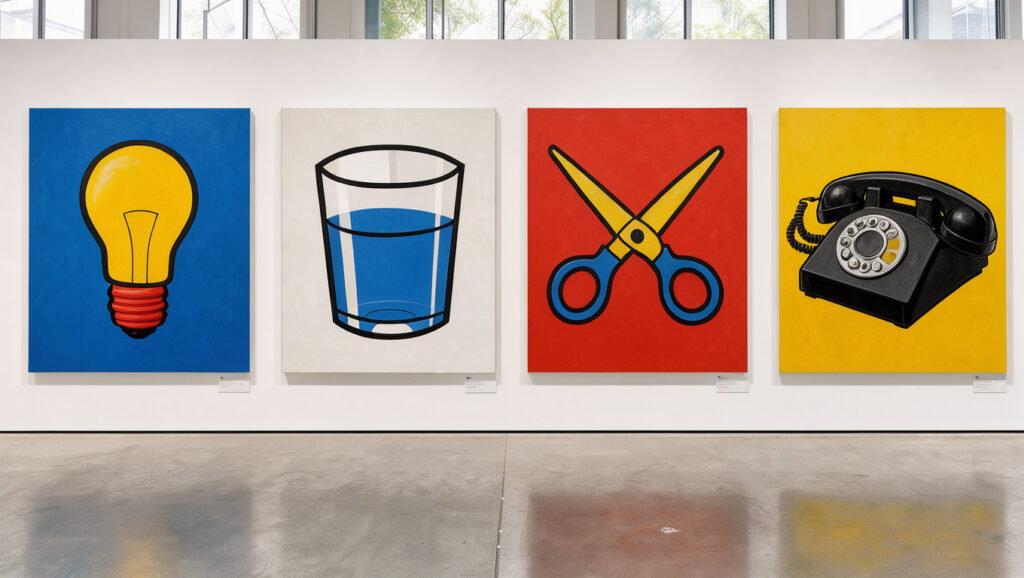
His practice begins with ordinary objects and moves through conceptual constructions, line drawings, and later painting in saturated colour. The objects he chose are often familiar household items, which he presents in a deliberately plain way.
What Is An Oak Tree by Michael Craig-Martin?
An Oak Tree, dated 1973, consists of a glass of water on a shelf. A printed text in question-and-answer form accompanies it, in which the artist claims to have changed the glass of water into an oak tree “without altering the accidents.” The work is made of glass, water, metal, and printed text on paper.
The work is catalogued as a 1973 piece by Gagosian, the gallery that represents him. One critical description calls it a turning point in conceptual art.
The work also caused a customs problem. Australian Customs barred it as vegetation, and the artist had to explain that it was a glass of water, as The Spectator Australia reports. The seizure is dated to 1976, and the National Gallery of Australia’s acquisition of the work to 1977.
A claim circulates that Damien Hirst called the work the greatest piece of conceptual sculpture. It rests on secondary commentary and has not been traced to a primary source.
How Household Objects Came to Define His Later Work
In the 1970s, his work included wall-mounted sculptures and conceptual pieces that explored the artist’s role and the nature of objects, drawing on the influence of Marcel Duchamp. The Art UK feature on his work describes this period.
In the late 1970s and 1980s, he made line drawings of everyday objects using black crepe paper drafting tape and acetate projection. He worked in a deliberately “styleless” manner.
From the mid-1990s onward, his work shifted to saturated colour and painting. He depicted household objects such as sardine tins, lightbulbs, laptops, and shoes. More recent work has focused on what he calls objects of our time, including phones and trainers.
What Are the Key Facts About Michael Craig-Martin’s Life and Career?
Early Life in Dublin and the Move to the United States
He was born in Dublin in 1941. Accounts differ on when his family moved to the United States, giving either 1945 or 1946.
He grew up largely in the United States, principally in Washington, D.C. His schooling included a Catholic primary school and the English Benedictine Priory School, where he was exposed to religious imagery. He also studied at a Lycée in Bogotá and attended Fordham University in New York. Some accounts credit a classical Catholic education with shaping his grounding in logic and rhetoric. His biographical details are summarised in the Wikipedia biography.
For a different look at Dublin’s literary heritage, see James Joyce, famous works and Ulysses.
Education at Yale University
He began a painting course at Yale in autumn 1961, a period in which he was influenced by Josef Albers. Tutors named in accounts include Alex Katz and Al Held. The Yale artists in conversation listing gives a BA in 1963 and an MFA in 1966.
One account describes painting study at Yale from 1961 to 1963, followed by postgraduate study from 1964 to 1966. The Yale listing and another biography give a BA or BFA in 1963 and an MFA in 1966. This difference remains unresolved.
Role in British Conceptual Art
He moved to Britain in 1966 and taught at Bath Academy of Art, Corsham, and Canterbury College of Art. His first solo exhibition was held at the Rowan Gallery in London in 1969, and he was included in The New Art at the Hayward Gallery in 1972. That exhibition is described as the definitive show of British conceptual art.
He later taught at Goldsmiths, where he became a Professor of Fine Art and later a Professor Emeritus. Among the artists he taught were Damien Hirst, Gary Hume, and Sarah Lucas.
His major exhibitions include a Whitechapel Gallery retrospective, a 2006 show at the Irish Museum of Modern Art titled Works 1964–2006, and a 2015 Serpentine Gallery show covering 1981 to 2015. He was a trustee of the Tate Gallery from 1989 to 1999, and he was appointed CBE in 2000 or 2001.
Most accounts date the Whitechapel Gallery retrospective to 1989, while one gives 1996 for the same show. The conflict remains unresolved.
Where Can You Buy Michael Craig-Martin Prints?
Information about prints is limited and comes mostly from marketplace listings. No complete catalogue of his editions is available.
Early Works: Prints and Editions
One 1stDibs listing shows five works by him for sale under the heading prints and multiples. The listing gives no details of specific editions, dates, or sizes.
The Printed Editions profile says he works across line drawing, painting, wall paintings, sculpture, prints, and animation. It also states that he now works primarily with paint. The site lists prints from five specialist galleries but gives no specific edition information.
No record documents the print editions of An Oak Tree, their sizes, publishers, print dates, or prices. Whether a print edition of that work exists is therefore not established.
Art-market fraud is a documented problem, as the case described in Inigo Philbrick, the $86 million art scam shows. Edition details, provenance, and seller credentials therefore carry real weight when a print is offered.
Screenprint Series Formats
A dealer listing describes early works as prints and editions, with formats of six screenprints, 12 screenprints, and paper and image. These formats have not been confirmed against a primary record, so they remain unverified.
How Did Michael Craig-Martin’s Career Unfold?
- 1941: Born in Dublin (Royal Academy of Arts profile and Wikipedia biography)
- Autumn 1961: Begins a painting course at Yale, influenced by Josef Albers (Wikipedia biography and Yale listing)
- 1963: Completes a BA or BFA at Yale (Yale listing)
- 1966: Completes an MFA at Yale and moves to London (Yale listing and Gagosian)
- 1969: First solo exhibition at the Rowan Gallery, London (British Council collection record)
- 1972: Included in The New Art at the Hayward Gallery, London (Gagosian and British Council collection record)
- 1973: Creates An Oak Tree (Gagosian)
- 1973 or 1974: Begins teaching at Goldsmiths College of Art (accounts differ)
- 1977: National Gallery of Australia acquires An Oak Tree (Wikipedia biography)
- 2016: Knighted for services to art (Royal Academy of Arts profile)
What Is Certain About Michael Craig-Martin and What Remains Unclear?
| Established information | Information that remains unclear |
|---|---|
| Born in Dublin in 1941 | Exact year his family moved to the United States (1945 or 1946) |
| Studied painting at Yale University | Exact Yale degree dates, which differ between accounts |
| Moved to London in 1966 | Start year at Goldsmiths (1973 or 1974) |
| Created An Oak Tree in 1973 | Whether the Tate holds an artist’s copy; no Tate record confirms this |
| Knighted in 2016 for services to art | Current living status; nothing after 2024 confirms it |
| Prints and editions are offered by dealers | Edition sizes, dates, and pricing for specific prints |
A quotation about learning colour at Yale appears in some accounts, but it lacks a citation and is not treated as established here.
Why Does Michael Craig-Martin Matter in British Conceptual Art?
His significance rests partly on his role as a teacher. He is described as an influential teacher of the Young British Artists at Goldsmiths, and Damien Hirst, Gary Hume, and Sarah Lucas are named among his students.
His work also connects British art with questions about objects and representation. An Oak Tree, in particular, is discussed as a work that asks how a text can change the meaning of a plain object. His works are held in collections including the Tate and the Victoria and Albert Museum in London, MoMA in New York, the Centre Georges Pompidou in Paris, and the National Gallery of Australia in Canberra.
How Reliable Are the Sources on Michael Craig-Martin?
Museum and institutional pages carry more weight than dealer and marketplace pages. Several marketplace and biography pages reuse similar text, so they do not offer independent confirmation of the same facts.
Without altering the accidents.
The printed text accompanying An Oak Tree, as quoted in accounts of the work
Now works primarily with paint.
Printed Editions, artist profile
What Should Readers Take Away About Michael Craig-Martin?
Michael Craig-Martin is a Dublin-born conceptual artist and painter who studied at Yale, built his career in London, and is known for An Oak Tree and his paintings and prints of everyday objects. No confirmed information about his status after 2024 is available, and several dates remain disputed. For the most current information, recent news and official statements from his galleries and institutions are the best places to look.
Frequently Asked Questions
Where did Michael Craig-Martin study painting?
He studied painting at Yale University, starting in autumn 1961. A Yale listing gives a BA in 1963 and an MFA in 1966, while other accounts describe the dates differently.
When did Michael Craig-Martin move to London?
Sources consistently give 1966 as the year he moved to Britain and settled in London. He has been based there since.
Which honour did Michael Craig-Martin receive?
He was knighted in 2016 for services to art. He had earlier been appointed CBE, in either 2000 or 2001, according to the sources.
Which Young British Artists did he teach?
Sources name Damien Hirst, Gary Hume, and Sarah Lucas among the Young British Artists he taught at Goldsmiths.
Which galleries represent Michael Craig-Martin?
Gagosian and Cristea Roberts Gallery in London represent him, according to the sources. Krakow Witkin Gallery has also shown his work.
More related posts
 Utilita Arena Birmingham Seating Plan – Chart & Best Seats
 Molly McCann – Record, Next Fight, Height and Net Worth 2025
 How Many mL in a Cup – US 236.6, Metric 250 Guide
 Black Orchid Tom Ford – Notes, Longevity and Unisex Guide
 Anthony Mackie – Biography, Net Worth, Movies, and Meme
 Joe Wicks – Biography, Workout Method, Net Worth & Family
 Hedy Lamarr – Hollywood Star Who Invented the Future of Wireless
 Moriah Elizabeth – Age, Husband, Net Worth, and Pickle
