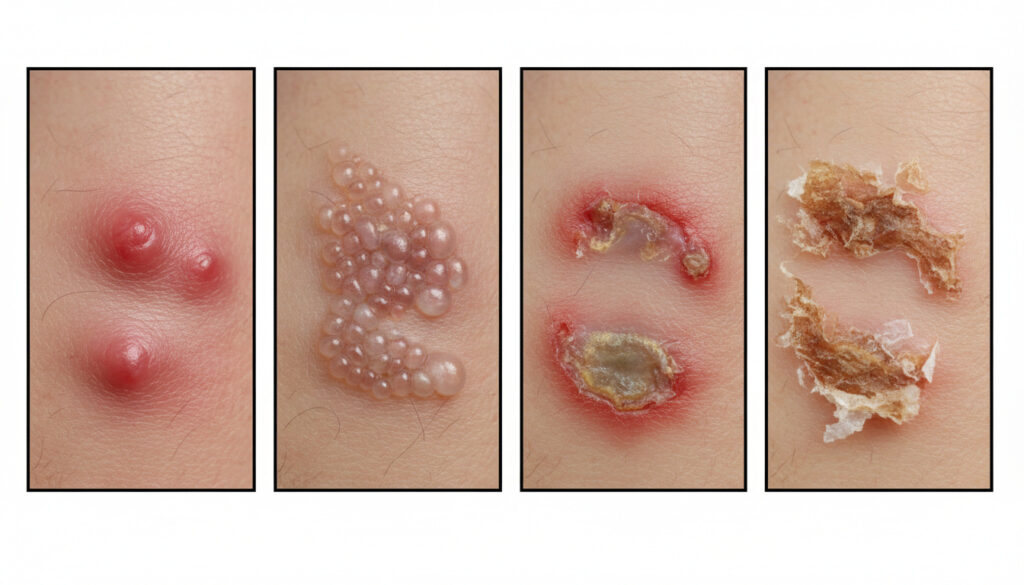
What Does Herpes Look Like – Stages, Symptoms and Differences
Herpes simplex virus produces distinctive fluid-filled blisters that advance through predictable stages, though visible signs vary significantly based on virus type and anatomical location. The condition manifests primarily through two strains: HSV-1, traditionally associated with oral cold sores, and HSV-2, which typically affects genital regions, though either type can infect either location through direct contact with bodily fluids.
Visual identification remains challenging because the infection evolves rapidly from subtle redness to clustered lesions, often resembling other common skin conditions during early phases. Understanding these morphological changes helps distinguish herpetic outbreaks from similar dermatological issues, though clinical confirmation through laboratory testing remains essential for accurate diagnosis.
What Does Herpes Look Like?
Herpetic lesions present differently depending on whether HSV-1 or HSV-2 causes the infection, though both produce characteristic grouped vesicles on inflamed skin bases. Oral herpes typically emerges around lip margins and facial skin, while genital herpes affects vulvar tissue, penile skin, or perianal regions, occasionally appearing inside vaginal canals or urethras where visual detection proves difficult.
Cold sores on lips, chin, tongue, facial skin
Lesions on vulva, penis, perianal area, internal vaginal walls
Clusters of fluid-filled blisters on red bases
50-80% of adults carry HSV-1; 11-20% carry HSV-2
- Early-stage herpes mimics pimples or ingrown hairs, causing frequent misdiagnosis
- Blister clusters typically cause 7/10 pain intensity, significantly worse than acne
- Asymptomatic carriers comprise the majority of infected individuals, showing no visible sores
- Transmission can occur during asymptomatic viral shedding without visible lesions
- Oral-to-genital transmission via oral sex has increased genital HSV-1 cases significantly
- Recurrent outbreaks usually present less severe than primary infections
| Characteristic | Details |
|---|---|
| Incubation Period | 2-12 days post-exposure |
| Contagious Window | Highest during blister phase; possible during asymptomatic shedding |
| Global HSV-1 Prevalence | Approximately 67% of population under age 50 |
| Lesion Duration | 2-4 weeks from initial symptoms to complete healing |
| Prodrome Duration | Up to 48 hours before visible sores appear |
| Pain Character | Constant burning, worsened by touch or friction |
What Are the First Signs of a Herpes Outbreak?
The initial phase, known as prodrome, introduces neurological sensations before any visible skin changes occur. Warning signs appear 2-12 days after exposure and persist for up to 48 hours. Patients typically report localized tingling, itching, or burning sensations. Accompanying skin redness and minimal swelling often escapes notice due to its transient nature lasting approximately 24 hours.
Recognizing Prodrome Symptoms
Systemic symptoms frequently accompany genital herpes prodrome, including low-grade fever, headache, and swollen lymph nodes in the groin area. These constitutional signs rarely appear with oral herpes recurrences, helping clinicians distinguish between primary and subsequent outbreaks while indicating the virus’s migration through peripheral nerves toward skin surfaces.
Where Do Herpes Sores Typically Appear?
Oral herpes favors the vermilion border of lips but regularly extends to the chin, skin below the nose, and tongue surface. In females, lesions commonly affect the vulva’s external structures including labia majora and minora, though internal vaginal lesions remain common and frequently undetected without speculum examination. Male presentations typically involve the penile shaft or glans, with both sexes experiencing potential perianal involvement.
Initial redness and papules often resemble minor skin irritation or early acne, lasting only about 24 hours before progressing to vesicles. This brief window explains why many patients miss the earliest stage entirely, presenting only after painful blisters have fully formed.
Does Herpes Look Like Pimples or Other Skin Issues?
Visual confusion between herpetic lesions and common skin conditions represents one of the most frequent diagnostic challenges in clinical practice. Herpes blisters initially resemble small papules or pimples, but several distinguishing features help differentiate them from acne vulgaris, ingrown hairs, or contact dermatitis.
Distinguishing Herpes from Acne
Unlike pimples, which typically present as solitary raised bumps with white or black heads, herpetic lesions cluster together on the same erythematous base. The fluid within herpes blisters remains clear or yellowish and watery rather than the thick, opaque pus characteristic of bacterial acne. Additionally, herpes causes constant neuropathic pain rated approximately 7/10, whereas acne discomfort usually registers as mild tenderness only when touched.
Conditions Commonly Confused with Herpes
Ingrown hairs produce isolated painful bumps that may contain pus but lack the grouped vesicle pattern. Shaving irritation creates diffuse redness without discrete blisters. Syphilis chancres present as single, painless ulcers rather than multiple painful vesicles. Canker sores occur exclusively inside the mouth on soft tissue, never on external lip skin where cold sores emerge.
How Does Herpes Progress and Heal?
Herpetic outbreaks follow a predictable chronology from nerve irritation to complete resolution, with each stage presenting distinct visual characteristics. Understanding this temporal pattern helps patients anticipate transmission risks and recognize when lesions become increasingly contagious or finally non-infectious during recovery.
Open sores containing clear or yellowish fluid represent the highest transmission risk. Direct contact with this exudate or the blister base can spread HSV to new locations on the patient’s body or to sexual partners through saliva or genital secretions.
Stage One: Initial Redness and Bumps
The virus travels through local sensory nerves to the epidermis, causing erythema and small raised bumps with minimal edema. Patients experience intensifying burning and tingling sensations as viral particles accumulate within keratinocytes. People typically experience mild burning and tingling during this phase.
Stage Two: Blister Formation
Fluid-filled blisters form 1-3 days after the initial rash. These thin-walled vesicles develop containing minimal amounts of clear or serous fluid. They appear in tight clusters on the same inflammatory base, varying in shape while maintaining a translucent, delicate appearance that distinguishes them from the thicker-walled bullae seen in thermal burns.
Stage Three: Rupture and Ulceration
The blister roof opens after 1-3 days, leaving shallow open sores that exude serous fluid or blood. This ulcerative phase exposes raw nerve endings, often causing the most intense discomfort during the entire outbreak. The exposed dermis appears moist and red, creating a fertile environment for secondary bacterial infection if not kept clean.
Stage Four: Crusting and Resolution
Scabs form as ulcers heal, marking the beginning of decreased contagiousness. Drying begins from the periphery inward, forming honey-colored or dark crusts. Complete healing without scarring typically requires 2-4 weeks from initial symptom onset, though the skin may remain temporarily discolored.
While primary outbreaks generally require 2-4 weeks for full resolution, recurrent episodes often heal faster, sometimes resolving within 7-10 days. Immunocompromised individuals may experience prolonged ulceration and delayed crusting requiring antiviral intervention.
How Long Do Herpes Outbreaks Last?
The clinical course of herpes follows a predictable temporal pattern from exposure to resolution, though individual experiences vary based on immune status, viral load, and whether the episode represents a primary or recurrent infection. The following chronology outlines the typical progression for a first-time outbreak.
- Days 0-12 (Incubation): Virus establishes latency in sensory ganglia after contact with infected bodily fluids. No visible symptoms occur during this phase.
- Days 2-12 (Prodrome): Viral migration begins toward skin surface, causing tingling, burning, or itching 24-48 hours before visible lesions appear.
- Days 1-3 (Vesicular): Fluid-filled blisters emerge on red bases, reaching maximum size and pain intensity. This stage carries highest transmission risk.
- Days 4-7 (Ulcerative): Blisters rupture leaving open sores that ooze clear or yellowish fluid. Pain remains intense; risk of secondary infection increases.
- Weeks 2-4 (Crusting/Healing): Scabs form over ulcers, gradually shrinking as epithelial tissue regenerates from the edges inward. Contagiousness decreases significantly once dry crust covers lesions.
Can You Diagnose Herpes by Appearance Alone?
Visual inspection alone provides insufficient certainty for definitive herpes diagnosis, though characteristic patterns offer strong diagnostic clues. Clinical confirmation requires laboratory testing, particularly because asymptomatic shedding and atypical presentations complicate visual assessment.
| Visually Established | Visually Unclear |
|---|---|
| Grouped vesicles on erythematous bases | Asymptomatic carriers with no visible lesions |
| Thin-walled blisters with clear/yellow fluid | Atypical presentations resembling fissures or folliculitis |
| Pain intensity disproportionate to lesion size | Internal lesions requiring speculum examination |
| Typical locations: lip vermilion, vulva, penile shaft | Healing sores indistinguishable from healed wounds |
| Predictable progression through four stages | Concurrent infections masking typical appearance |
How Common Is Asymptomatic Herpes?
The majority of individuals infected with herpes simplex virus remain unaware of their status, never developing recognizable lesions or experiencing symptoms so mild they attribute them to minor skin irritation. Most people infected with HSV are asymptomatic or have very mild symptoms. This asymptomatic reservoir drives continued transmission, as carriers shed virus intermittently without warning signs.
Global prevalence data indicates approximately 67% of the world’s population under age 50 harbors HSV-1, while roughly 11-20% carry HSV-2, though many regional variations exist. Many don’t know they have the virus, yet can still transmit it to others. The disconnect between infection rates and diagnosed cases highlights the inadequacy of visual diagnosis alone. Katie Price Before and After – Full Plastic Surgery Timeline
What Do Health Organizations Say About Herpes Symptoms?
Major health authorities emphasize the silent nature of herpes epidemics, noting that visual recognition fails to identify most carriers. Their clinical guidance stresses testing over visual assessment for accurate public health surveillance.
Most people infected with HSV are asymptomatic or have very mild symptoms. Many don’t know they have the virus, yet can still transmit it to others.
Mayo Clinic
Most people with the virus don’t have symptoms. It is important to know that even without signs of the disease, it can still spread to sexual partners.
Centers for Disease Control and Prevention
What Should You Remember About Herpes Appearance?
Herpes typically presents as clusters of painful, fluid-filled blisters progressing through redness, vesicle formation, rupture, and crusting over 2-4 weeks. While HSV-1 favors oral locations and HSV-2 prefers genital sites, either virus can infect either location. Visual identification remains unreliable due to asymptomatic carriage and lookalike conditions including acne and ingrown hairs. Laboratory confirmation remains necessary for anyone suspecting infection rather than relying on self-diagnosis based on appearance alone. Cast of a Muppet Christmas Carol – Every Role and Performer
Frequently Asked Questions
How long do herpes sores last?
Primary outbreaks typically resolve in 2-4 weeks from initial symptom onset to complete healing. Recurrent episodes usually heal faster, often within 7-10 days.
Can herpes be mistaken for something else?
Yes. Early herpes resembles pimples, ingrown hairs, or shaving irritation. Unlike acne, herpes lesions cluster together and contain clear fluid rather than pus.
Is herpes always painful?
Pain levels vary, but active lesions typically cause significant discomfort rated around 7/10. However, many carriers remain completely asymptomatic, experiencing no pain or visible sores.
Can you transmit herpes without visible sores?
Yes. Asymptomatic viral shedding allows transmission even when no lesions are present. Most transmissions occur during these asymptomatic periods.
Does herpes recur in the same location?
Generally yes. The virus lies dormant in specific nerve ganglia, causing recurrences to appear in the same dermatome or nearby areas served by those nerves.
What does healing herpes look like?
Healing herpes develops dry crusts or scabs that gradually shrink from the edges inward. Once fully crusted, contagiousness decreases significantly while skin regenerates beneath.
More related posts
 Molly McCann – Record, Next Fight, Height and Net Worth 2025
 Richard Ashcroft – Biography, Net Worth and 2025 Tour Dates
 111 Angel Number Meaning – Spiritual Guide to New Beginnings
 Next Premium Bond Draw – Full 2026 Schedule & Prize Checker
 Sheffield United vs Portsmouth – Match Preview and Key Facts
 Eid ul Adha 2025 UK – Date, Prayers, Holiday Status
 Bobbi Althoff – Age, Husband, Kids, Net Worth and Rise to Fame
 Inigo Philbrick – The True Story of the $86 Million Art Scam
