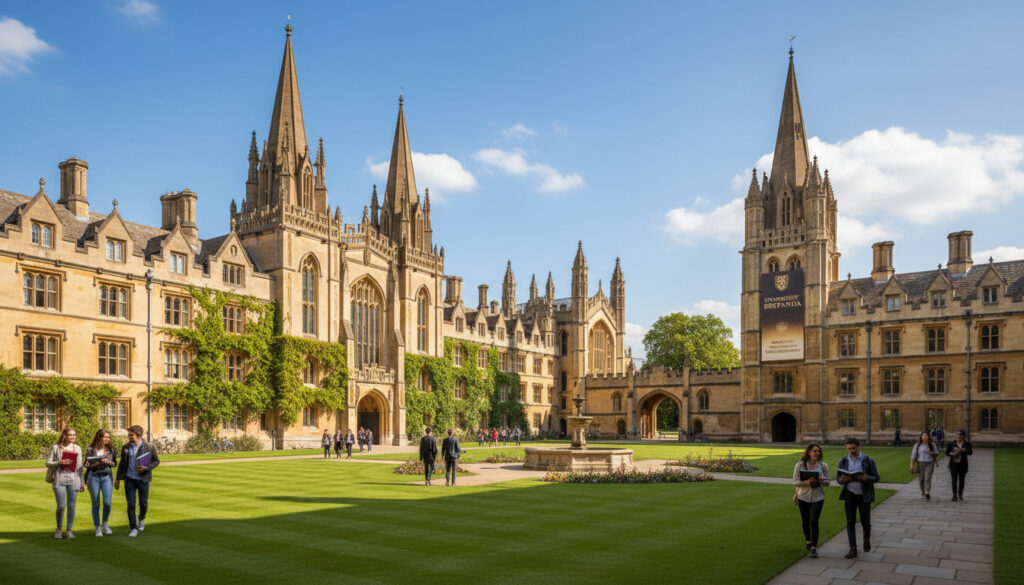
Best Universities in UK – 2025 QS, THE, Guardian Rankings
British higher education maintains its global dominance in 2025, with UK institutions securing multiple positions in international top tens. The hierarchy of excellence varies significantly depending on whether you consult QS World University Rankings, Times Higher Education, or The Guardian University Guide, creating a complex landscape for prospective students.
Current league tables reveal divergent verdicts at the summit. While the University of Oxford achieves a perfect score of 100 in The Guardian 2025 rankings and leads Times Higher Education’s assessment, Imperial College London claims the top UK position in QS metrics. This disparity underscores a fundamental truth: the “best” university depends entirely on which educational priorities you value most.
What Are the Best Universities in the UK?
Top Overall (QS)
Imperial College London
Ranked first in the UK by QS World University Rankings 2025, third by Times Higher Education.
Best for Student Experience
University of Oxford
Achieved a perfect score of 100 in The Guardian 2025 rankings, emphasizing teaching satisfaction and career prospects.
Research Excellence Leader
University of Oxford
Ranks first in Times Higher Education 2025, which emphasizes research output and international collaboration.
Rising Institution
University of Bath
Has demonstrated notable improvement over the past decade and now ranks seventh in The Guardian 2025 guide.
- The University of Oxford achieved a perfect score of 100 in The Guardian 2025 rankings, reclaiming the top position from the University of St Andrews.
- Imperial College London ranks as the number one UK university in the QS World University Rankings 2025.
- The University of St Andrews, which held first place in The Guardian 2024 rankings, now occupies second place in the 2025 guide.
- Rankings vary dramatically by methodology: St Andrews places second in The Guardian but 24th in Times Higher Education.
- The University of Bath has shown consistent improvement over the past decade and is now firmly established among the top UK universities.
- Four London institutions—Imperial College London, London School of Economics, University College London, and Warwick—feature prominently across all major top tens.
- QS rankings include over 1,500 universities globally based on six key indicators, while The Guardian evaluates eight specific criteria including teaching satisfaction and staff-to-student ratios.
| Rank (Guardian) | University | QS 2025 | THE 2025 | Location | Key Metric |
|---|---|---|---|---|---|
| 1 | University of Oxford | 2 | 1 | Oxford | Perfect Guardian Score |
| 2 | University of St Andrews | 16 | 24 | St Andrews | Previous Guardian #1 |
| 3 | University of Cambridge | 3 | 2 | Cambridge | Consistent Top Three |
| 4 | London School of Economics | 8 | 7 | London | Social Sciences Focus |
| 5 | Imperial College London | 1 | 3 | London | QS UK Leader |
| 6 | University of Durham | 15 | 22 | Durham | Collegiate System |
| 7 | University of Bath | 22 | 32 | Bath | Decade of Improvement |
| 8 | University of Warwick | 10 | 13 | Coventry | Research Intensity |
| 9 | University College London | 4 | 4 | London | Global Reach |
| 10 | Loughborough University | 29 | 35 | Loughborough | Student Experience |
What Is the Number 1 University in the UK?
No single institution holds undisputed claim to the top position across all evaluation systems. The University of Oxford leads both The Guardian 2025 guide and Times Higher Education’s 2025 rankings, while Imperial College London occupies the summit of QS World University Rankings.
The Guardian’s Verdict: Student-Centric Excellence
The Guardian University Guide 2025 awarded Oxford a perfect score of 100, citing exceptional performance in teaching satisfaction, feedback quality, and graduate employment rates within 15 months of completion. This methodology emphasizes the student lifecycle and educational experience over pure research output.
QS World Rankings: Global Academic Reputation
Imperial College London ranks first among UK institutions in the QS World University Rankings. This system incorporates academic reputation surveys, employer reputation, faculty-to-student ratios, citations per faculty, international faculty ratio, and international student ratio.
Times Higher Education: Research and Innovation
Oxford retains the top UK position in Times Higher Education’s 2025 assessment, which weights research volume, income, and reputation more heavily than teaching metrics. Cambridge follows at second place in this particular hierarchy.
The variation in top positions stems from fundamental methodological differences. QS emphasizes global academic reputation surveys (40% of score), while The Guardian focuses exclusively on undergraduate student experience metrics. Times Higher Education balances teaching, research, and international outlook.
How Do Major Rankings Like QS and Times Higher Education Compare UK Universities?
Each major ranking system employs distinct criteria that reward different aspects of university performance. Understanding these methodologies explains why identical institutions occupy vastly different positions across league tables.
QS World University Rankings Methodology
QS evaluates over 1,500 universities globally using six indicators. Academic reputation constitutes the largest weighting through global surveys, followed by employer reputation. Faculty-to-student ratios measure teaching capacity, while citations per faculty assess research impact. International faculty and student ratios comprise the remaining metrics.
Times Higher Education Approach
THE employs a balanced scorecard across teaching, research, citations, international outlook, and industry income. Research metrics include volume, income, and reputation. The system examines the ratio of doctoral degrees to bachelor’s degrees awarded and institutional income scaled against student numbers.
The Guardian’s Student-Focused Criteria
The Guardian University Guide utilizes eight specific criteria: teaching satisfaction, feedback satisfaction, staff-to-student ratios, expenditure per student, entry tariff requirements, career prospects after 15 months, degree continuation rates, and an overall value-added score. This approach prioritizes the entire student lifecycle and overall experience over research prestige.
Oxford or Cambridge: Which Is Better?
The ancient rivalry between England’s oldest universities continues in contemporary rankings, with both institutions trading positions depending on evaluation criteria. Oxford currently holds the advantage in domestic rankings, while Cambridge maintains comparable international standing.
Head-to-Head in 2025 Rankings
Oxford leads Cambridge in both The Guardian 2025 (first versus third) and Times Higher Education 2025 (first versus second). However, QS World University Rankings place Cambridge third and Oxford second among UK institutions, though both trail Imperial in that specific metric.
Methodological Strengths
Oxford outperforms Cambridge in student satisfaction metrics and graduate employment rates within 15 months, according to The Guardian data. Cambridge demonstrates stronger performance in certain research intensity measures utilized by Times Higher Education, though Oxford maintains the overall lead in that ranking.
Both universities trace their origins to the medieval period—Oxford receiving royal recognition in the 12th century and Cambridge founded in 1209. This historical continuity contributes to their endowment advantages and global brand recognition, factors that influence reputation surveys in QS rankings.
While Oxford leads in aggregate rankings, specific subject areas may favor either institution. Times Higher Education and Complete University Guide provide subject-specific rankings across 74 subject areas where the hierarchy may differ significantly from overall institutional standings.
How Have UK University Rankings Changed in Recent Years?
The 2025 rankings reveal several significant shifts in institutional fortunes, with ancient universities reclaiming dominance and rising stars challenging established hierarchies.
-
The University of St Andrews held the top position in The Guardian University Guide, breaking the Oxford-Cambridge duopoly at the summit of domestic rankings.
-
The University of Oxford reclaimed first place in The Guardian 2025 rankings with a perfect score of 100, driven by strong student satisfaction scores and graduate employment rates.
-
Imperial College London achieved first place among UK institutions in the QS World University Rankings 2025, reflecting its strength in technical and medical sciences.
-
The University of Bath has demonstrated notable improvement over the past ten years, establishing itself firmly within the top tier of UK universities and ranking seventh in The Guardian 2025 guide.
What Do We Know for Certain About UK University Rankings?
While aggregate rankings provide useful benchmarks, distinguishing verified data from marketing claims remains essential for prospective students.
| Established Information | Information Not Currently Available |
|---|---|
| Oxford ranks first in THE 2025 and Guardian 2025 with a perfect score of 100 | Specific international student tuition fees for each institution |
| Imperial College London ranks first in QS 2025 UK rankings | Detailed international student population demographics |
| St Andrews placed first in Guardian 2024 and second in 2025 | Employability metrics broken down by specific subject areas |
| Bath has improved significantly over the past decade | Comparative data for computer science and engineering programs |
| Guardian rankings evaluate eight specific criteria including career prospects after 15 months | Post-Brexit changes to international student recruitment statistics |
| QS rankings include over 1,500 global institutions using six indicators | Return on investment calculations by degree program |
Why Do University Rankings Matter?
League tables influence employer perceptions, research funding allocations, and international recruitment. Institutions ranked in global top tens attract disproportionate research income and partnership opportunities. For students, rankings offer one metric among many for evaluating institutional quality, though they cannot capture departmental culture or individual program suitability.
University rankings function similarly to sports league tables, where performance metrics determine standing. Just as the Belgian Pro League Standings – 2024/25 Regular Season Table reflects seasonal athletic performance through accumulated points, university rankings aggregate metrics across teaching, research, and international outlook.
The Guardian’s focus on student experience metrics—teaching satisfaction, feedback quality, and career prospects—provides prospective undergraduates with insight into daily educational realities. Conversely, QS and THE rankings better reflect research intensity and global academic reputation, factors that particularly influence postgraduate study decisions.
What Do Ranking Organizations Say About Their Methods?
Ranking bodies emphasize that their methodologies reflect distinct educational values. The Guardian’s approach specifically targets undergraduate student experience rather than research prestige.
The Guardian Rankings evaluate universities across eight criteria: teaching satisfaction, feedback satisfaction, staff-to-student ratios, expenditure per student, entry requirements, career prospects after 15 months, degree continuation rates, and an overall score out of 100.
The Guardian University Guide 2025, via Time Out
This approach emphasizes the entire student lifecycle and overall experience.
Analysis of Guardian Methodology
QS rankings incorporate global academic reputation surveys representing the views of thousands of academics worldwide, while Times Higher Education balances teaching and research metrics with international collaboration indicators.
Which UK University Should You Choose?
Your optimal choice depends on academic priorities. For research-intensive postgraduate study, Oxford and Cambridge maintain global dominance. For undergraduate teaching quality and student satisfaction, Oxford leads current domestic metrics, while St Andrews offers a compelling alternative outside the traditional power structure. Imperial provides the strongest showing in technical fields according to QS metrics. Consult subject-specific rankings, such as those covering What Is the Mean – Definition, Formula and Examples in statistical methodologies, before making final decisions.
Frequently Asked Questions
What are the best UK universities by subject?
Times Higher Education and Complete University Guide provide comprehensive subject-specific rankings across 74 subject areas. The hierarchy varies significantly by discipline, with different institutions leading in medicine, engineering, humanities, and social sciences.
What are entry requirements for top UK universities?
The Guardian rankings consider entry tariff requirements as one of eight criteria, but specific A-level or International Baccalaureate requirements vary by course and change annually. Applicants should consult individual university admissions pages for current standards.
How much do international students pay at top UK universities?
Specific international student fee schedules for the 2024/25 or 2025 academic years were not available in the current ranking data. Fees vary significantly by subject, with laboratory-based courses typically commanding higher tuition than classroom-based programs.
Is the University of St Andrews better than Oxford?
St Andrews ranked second in The Guardian 2025 guide, behind Oxford, but leads in specific student satisfaction metrics. However, Oxford ranks significantly higher in global rankings like QS and THE. “Better” depends on whether you prioritize teaching satisfaction (St Andrews excels) or research reputation (Oxford leads).
Which UK university has the best graduate employability?
Oxford’s perfect Guardian score partly reflects strong career prospects after 15 months. However, specific employability metrics by subject, including computer science and engineering comparisons, were not available in the current data set.
Why do rankings differ so much between QS and The Guardian?
QS emphasizes global academic reputation and research citations, while The Guardian focuses exclusively on undergraduate teaching quality, student feedback, and early career outcomes. These different weightings explain why St Andrews ranks second domestically but 16th in QS global rankings.
What is the best university for international students in the UK?
University College London and Imperial College London both rank highly in international outlook metrics. However, specific data regarding international student populations, support services, and fees was not available in the current ranking reports.
More related posts
 Pain in Right Side – Common Causes and When to Seek Help
 Smashing Machine – Dwayne Johnson as UFC Legend Mark Kerr
 Happy New Year 2026 – Wishes, Free Images and Key Dates
 How Much Is a – Complete Price Guide for 2025 UK Costs
 M and S Bras – Complete Guide to Non Wired and Plus Size Styles
 Cast of Moana 2 – Full Voice Actors List and Roles
 FC Barcelona vs Girona FC Timeline – All Matches and Results
 B&Q Li burn – Opening Hour , Service and Acce ibility 2025
