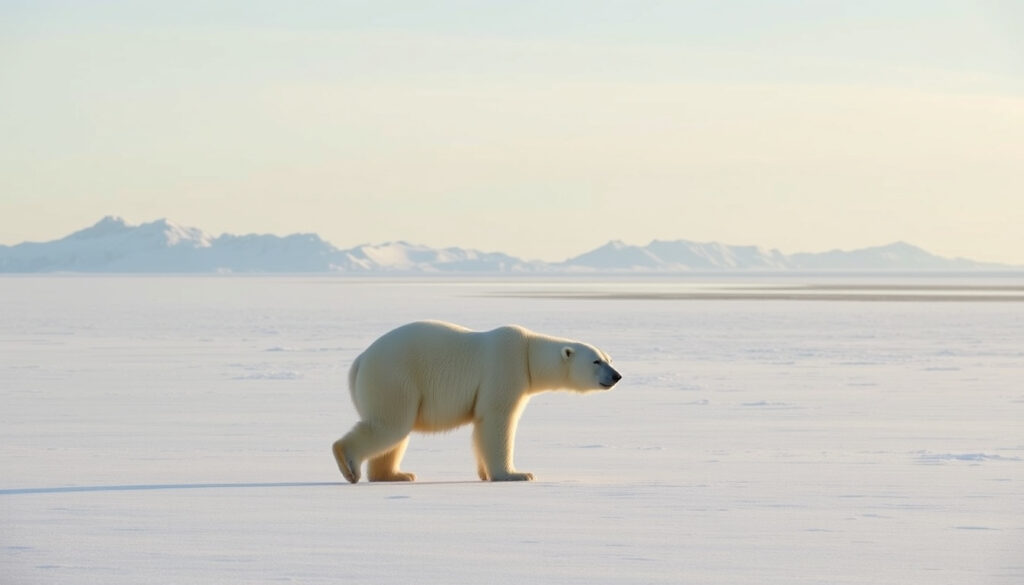
Polar Bear – Size, Diet, Habitat, and Conservation Facts
The polar bear, known scientifically as Ursus maritimus, is the largest land carnivore and an apex predator of the Arctic. Contrary to a common belief, the species is not globally classified as endangered; the International Union for Conservation of Nature (IUCN) has listed it as vulnerable since 2006. The central and long-term threat to polar bears is the loss of sea ice caused by climate change.
These magnificent animals are uniquely adapted to life on the frozen ocean. They inhabit coastal areas and sea ice across the Arctic, relying on this platform to hunt their primary prey: seals. With an estimated global population of around 26,000 individuals spread across 19 to 20 subpopulations, polar bears remain a species of high concern but not yet at the brink of extinction.
Understanding the polar bear means examining its size, diet, habitat, and the challenges it faces in a rapidly warming world. This article compiles verified facts from authoritative sources to answer the most common questions about the Arctic’s top predator.
How Big Is a Polar Bear? Size, Height, and Weight Compared to Other Bears
- Polar bears are the largest land carnivores on Earth.
- Adult males are much larger than females, with reported weight ranges of 410–720 kg (Britannica) to 300–800 kg (compiled sources).
- A large male can stand over 3.3 m tall on its hind legs, though normal posture is on all fours with a shoulder height around 1.6 m.
- Body length for males is commonly about 2.2–2.5 m.
- Climate change and sea ice loss are the primary threats to polar bear survival.
- The global polar bear population is estimated at 26,000, divided into 20 subpopulations.
| Fact | Detail |
|---|---|
| Largest bear species | Adult males can weigh up to 800 kg (1,760 lb) |
| Top Arctic predator | Primary diet consists of ringed and bearded seals |
| Geographic range | Circumpolar: Alaska, Canada, Russia, Greenland, Norway |
| Conservation status | IUCN: Vulnerable (population stable but habitat threatened) |
| Scientific name | Ursus maritimus |
| Key adaptation | Translucent fur, black skin, thick fat layer for insulation |
How tall is a polar bear when standing on its hind legs?
A large male polar bear can stand over 3.3 meters (10.8 feet) tall on its hind legs, according to the National Wildlife Federation. However, that is not its normal posture. On all fours, the shoulder height is about 1.6 meters (5.2 feet).
How much does an adult male polar bear weigh?
Adult male polar bears are much larger than females. Reported weight ranges vary: Britannica cites 410–720 kg, while Wikipedia‘s compilation of sources gives a broader range of 300–800 kg. Females typically weigh about half as much.
How does polar bear size compare to a grizzly bear?
Polar bears are generally larger than grizzly bears. While both species can reach impressive sizes, the polar bear is considered the largest land carnivore. Adult male grizzlies usually weigh 180–360 kg, significantly less than a polar bear’s upper range. The polar bear’s elongated neck and smaller ears also distinguish it physically.
Are Polar Bears Endangered? Conservation Status and Population in 2025
What is the current polar bear population estimate?
The global polar bear population is estimated at about 26,000 individuals across 19 populations as of 2021, according to the IUCN. Other sources provide a range of 22,000–31,000 by 2020 or 20,000–25,000, reflecting uncertainty in monitoring methods. The bears inhabit Arctic regions including Canada, Alaska, Russia, Greenland, and Svalbard.
Are polar bears going extinct due to climate change?
The central threat is sea ice loss, which shortens the hunting season and can lead to malnutrition or starvation. Bears are forced ashore earlier and spend more time in a food-poor environment. Some models cited by Britannica forecast a one-third decline by 2050 under compounded threats. However, not all subpopulations are declining; some are stable or recovering. The overall trend is downward due to sea ice loss.
While the IUCN lists polar bears as vulnerable, the status varies by region. Some subpopulations are decreasing, others are stable, and a few are increasing. The overall global trend is uncertain due to limited data from remote areas.
What is the IUCN Red List status for polar bears?
The IUCN has listed the polar bear as Vulnerable since 2006. It is not classified as endangered globally, though the United States listed it as Threatened under the Endangered Species Act in 2008. The IUCN assessment emphasizes that sea ice loss from climate change is the primary long-term threat.
What Do Polar Bears Eat? Diet and Hunting Behavior Explained
What is a polar bear’s primary food source?
Polar bears are mostly carnivorous and specialized seal hunters. Their main prey are ringed seals and bearded seals. They also take other pinnipeds and sometimes scavenge whale carcasses, dead fish, garbage, bird eggs, walruses, beluga whales, narwhals, fish, and marine invertebrates, according to Arctic Portal and other sources.
How do polar bears hunt seals on sea ice?
Polar bears rely on annual sea ice as a platform to hunt seals. They use their excellent sense of smell to locate seal breathing holes and patiently wait for seals to surface. They also stalk seals basking on the ice. The hunting season is critical for building fat reserves, which is why sea ice loss directly threatens their survival.
Polar bears have black skin beneath their translucent fur, which helps absorb heat, and a thick layer of fat that provides insulation and energy reserves. Hairy soles and specialized foot pads give them grip on ice.
Where Do Polar Bears Live? Habitat, Range, and Geographic Distribution
Which countries have wild polar bear populations?
Polar bears are found in five Arctic nations: Canada, Alaska (United States), Russia, Greenland (Denmark), and Norway (specifically Svalbard). They live in coastal areas and on sea ice throughout the Arctic.
Do polar bears live in Antarctica?
No. Polar bears are found only in the Arctic. They do not live in Antarctica. The two regions have different ecosystems; polar bears evolved in the northern hemisphere and are not present in the southern hemisphere.
How Do Polar Bears Survive the Arctic? Key Adaptations and Physical Traits
How do polar bear paws and fur help them survive cold?
Polar bears have thick fur and black skin that aid insulation and heat absorption. Their fur is translucent and hollow, appearing white due to light scattering. A thick layer of fat provides additional insulation and energy reserves. Hairy soles and specialized foot pads help with grip and walking on ice. Scientific concepts like isotope analysis help researchers study environmental changes; learn more: What Is an Isotope – Definition, Examples and Uses.
Are polar bears strong swimmers?
Yes, polar bears are excellent swimmers. They use their front limbs to propel themselves through water and have been known to swim for hundreds of miles. Their large webbed paws act as paddles, making them well-adapted to a marine environment.
Polar bears are often described as marine mammal-like because they depend on the ocean ecosystem for food and spend much of their lives on sea ice. Despite being bears, their ecological niche is closely tied to the Arctic marine environment.
Polar Bear Conservation Timeline: Key Milestones from 1973 to 2025
- – International Agreement on the Conservation of Polar Bears signed by Arctic nations.
- – IUCN lists polar bears as Vulnerable.
- – USA lists polar bears as Threatened under the Endangered Species Act.
- – Circumpolar Action Plan adopted for conservation.
- – Current estimate: ~26,000 polar bears in 20 subpopulations; sea ice continues to decline.
Polar Bear Myths, Facts, and Unknowns: What We Know and What Remains Unclear
| Established Information | Information That Remains Unclear |
|---|---|
| Polar bears do not live in Antarctica; they are exclusive to the Arctic. | Not all polar bear populations are declining. Some are stable or recovering, but the overall trend is downward due to sea ice loss. |
| Polar bear fur is translucent and hollow, not white; black skin lies underneath. | Exact population numbers are uncertain, with estimates ranging from 22,000 to 31,000 depending on the source and monitoring method. |
| The IUCN lists polar bears as Vulnerable, not Endangered. | How fast sea ice will continue to decline and its exact impact on different subpopulations remains an area of active research. |
Understanding the Polar Bear’s Future in a Warming Arctic
Climate change is the dominant factor shaping the polar bear’s future. As sea ice melts earlier in spring and forms later in autumn, bears lose access to their seal prey for longer periods. This forces them ashore where food is scarce, leading to malnutrition and reduced reproductive success. Some subpopulations in regions with more stable ice, such as the high Arctic, may fare better than those in the south. International conservation agreements, such as the Circumpolar Action Plan, aim to coordinate research and management, but global climate policy commitments are essential for long-term habitat preservation. Weather patterns play a role; see Indian Summer UK Weather – What to Expect in Autumn 2025 for related climate context.
Key Sources and Expert Perspectives on Polar Bears
Authoritative sources for polar bear information include the IUCN Polar Bear Specialist Group, which provides population estimates and subpopulation data; the World Wildlife Fund, which offers conservation status and habitat information; Polar Bears International, a specialist research organization with detailed population data; National Geographic, for behavioral and habitat descriptions; and the US Geological Survey, which conducts climate impact projections and sea ice studies. These organizations rely on peer-reviewed science and field research.
What’s Next for Polar Bears?
Continued monitoring of sea ice extent remains the primary indicator of polar bear health. If sea ice loss accelerates, the IUCN may reclassify the species as Endangered. Researchers are increasingly using AI and drone technology for population monitoring, addressing the question of ‘polar bear AI’. The growing importance of global climate policy commitments cannot be overstated for habitat preservation.
Frequently Asked Questions About Polar Bears
How fast can a polar bear run?
Polar bears can run at speeds up to 40 km/h (25 mph) on land, though they tire quickly.
What is polar bear AI?
Polar bear AI refers to artificial intelligence systems used by researchers to track, monitor, and identify individual polar bears using facial recognition and movement pattern analysis.
Can polar bears swim?
Yes, polar bears are strong swimmers and can swim for hundreds of miles using their large webbed front paws.
How long do polar bears live?
In the wild, polar bears typically live 15–18 years, though some can reach 30 years in captivity.
Are polar bears aggressive to humans?
Polar bears are the bear species most likely to attack humans, as they are natural predators and may view humans as prey, especially when food is scarce.
More related posts
 Used Cars for Sale Near Me – Top UK Sites and Cheap Deals
 Richard Ashcroft – Biography, Net Worth and 2025 Tour Dates
 Bill Turner Horse Trainer – Seattle Slew Triple Crown Trainer
 Mel Blatt – Age, Partner, Children and Burger Business in 2025
 Sheffield United vs Portsmouth – Match Preview and Key Facts
 Monica Barbaro Movies and TV Shows – Age, Husband, Net Worth 2025
 When Was Buckingham Palace Built – From Townhouse to Palace
 Colin Morgan Movies and TV Shows – Complete Filmography and Streaming Guide
