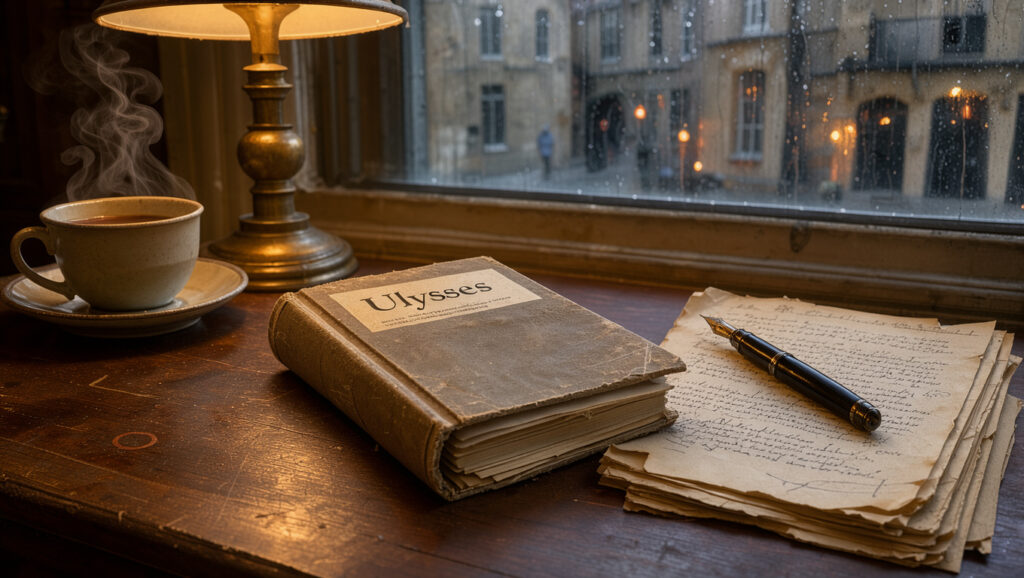
James Joyce – Famous Works, Ulysses and Key Facts Explained
James Joyce was an Irish novelist, short-story writer, and poet, and one of the most influential writers of the twentieth century. Born in in Rathgar, Dublin, he died in Zürich on . He is a central figure of literary Modernism.
His reputation rests on four major prose works: Dubliners (1914), A Portrait of the Artist as a Young Man (1916), Ulysses (1922), and Finnegans Wake (1939). Joyce spent most of his adult life in continental Europe, yet Dublin is the setting and subject of nearly all his fiction.
This guide covers his main works, the story of Ulysses, the circumstances of his death, his relationship with Nora Barnacle, and the family legacy that carries his name. It also notes where accounts differ.
What are James Joyce’s famous works?
Who he was
Irish novelist, short-story writer, and poet, and a key modernist. Born in Dublin in 1882 and died in Zürich in 1941.
Key works
Dubliners, A Portrait of the Artist as a Young Man, Ulysses, and Finnegans Wake.
Where he lived
Dublin, Trieste, Paris, and Zürich, with Dublin as the setting of most of his fiction.
Lasting influence
Ulysses and Bloomsday, and a profound effect on later writers of modernist fiction.
- His best-known books are built on experimental language, invented words, and puns.
- Stream-of-consciousness narration and free indirect style shape much of his prose.
- Dublin appears as a city of social and spiritual paralysis in his early fiction.
- Ulysses is the work most readers encounter first when they search for his name.
- Joyce lived abroad for most of his adult life, but he kept Dublin at the centre of his writing.
- His biography is closely tied to his books, from his Jesuit schooling to his exile.
| Fact | Detail |
|---|---|
| Full name | James Augustine Aloysius Joyce |
| Nationality | Irish |
| Born | 2 February 1882, 41 Brighton Square, Rathgar, Dublin |
| Died | 13 January 1941, Zürich, Switzerland |
| Known for | Ulysses, Dubliners, A Portrait of the Artist as a Young Man, Finnegans Wake |
| Partner | Nora Barnacle, married in 1931 |
| Notable grandson | Stephen James Joyce, son of Giorgio Joyce |
| Literary movement | Modernism |
Which James Joyce books should new readers start with?
Readers approaching Joyce for the first time often begin with the shorter, more accessible works. The Penguin publishing house suggests starting with Dubliners, a collection of 15 short stories. Its final story, “The Dead,” is widely regarded as one of the greatest short stories in English.
After Dubliners, A Portrait of the Artist as a Young Man follows Stephen Dedalus from childhood to his decision to leave Ireland. Ulysses and Finnegans Wake are generally read later because of their demanding style.
Public-domain editions of Joyce’s texts are available through Project Gutenberg, which can be useful for readers who want to compare editions.
What is Ulysses about?
Ulysses is set entirely in Dublin on 16 June 1904, a day now known as Bloomsday. The novel follows Leopold Bloom and Stephen Dedalus through the course of that single day.
How does Ulysses by James Joyce unfold?
The novel is loosely modelled on Homer’s Odyssey. Bloom parallels Odysseus, Molly Bloom parallels Penelope, and Stephen parallels Telemachus.
It comprises 18 episodes, each written in a different literary style and associated with particular organs, colours, arts, and sciences. Its final episode, Molly Bloom’s unpunctuated interior monologue, is among the most celebrated passages in twentieth-century fiction.
Ulysses was published in Paris by Sylvia Beach of Shakespeare and Company on 2 February 1922, Joyce’s fortieth birthday. Sources report that it was banned in the United States and Britain for years, and that hundreds of copies were seized in the 1920s.
Many readers approach Ulysses after Dubliners and A Portrait of the Artist as a Young Man, since both introduce Dublin and Stephen Dedalus. This is a suggested order, not a requirement.
Summaries of Ulysses describe its structure and themes, but interpretations of its meaning vary among critics and readers.
Why is Bloomsday commemorated?
Bloomsday marks 16 June, the single day on which the novel takes place. The date gives the book a fixed point that readers around the world recognise.
The novel’s connection to Dublin is central to this commemoration. Joyce’s home city is the setting for every episode.
What was the cause of James Joyce’s death?
James Joyce died in Zürich on 13 January 1941, after surgery. Writers Inspire records that he was buried in Fluntern cemetery in Zürich.
Accounts describe the cause of death in slightly different terms. Some sources point to a perforated ulcer, while others describe complications from intestinal surgery. The widely reported medical summary links his death to peritonitis following surgery for a perforated ulcer.
Where did James Joyce die and where is he buried?
Joyce died in Zürich, Switzerland, where he had lived in his later years. He was buried in Fluntern cemetery in the same city.
His final years were also marked by chronic eye disease, which led to repeated surgeries and periods of near or total blindness.
What do James Joyce’s love letters to Nora Barnacle reveal?
Nora Barnacle was Joyce’s partner for much of his adult life. The couple left Dublin together in 1904, and they had two children, Giorgio and Lucia. They married in 1931.
Joyce’s letters to Nora are known for their frankness and, in parts, for being sexually explicit. Readers who want to study the full text should consult scholarly editions rather than relying on excerpts.
Joyce’s manuscripts and archival material are held by the National Library of Ireland, which is a useful starting point for readers researching his personal papers.
Who is Stephen James Joyce?
Stephen James Joyce is a grandson of James Joyce. He is the son of Giorgio Joyce, the couple’s son.
His name often causes confusion with the author’s, but the two are separate people. The shared name reflects the family line rather than any shared identity.
How did James Joyce’s life and career unfold year by year?
- : Joyce is born at 41 Brighton Square, Rathgar, Dublin (source: IMDb profile).
- : He leaves Dublin with Nora Barnacle and travels toward Trieste, then lives in Pola, Trieste, Zürich, and Paris (source: Britannica).
- : Dubliners is published.
- : A Portrait of the Artist as a Young Man is published.
- : Ulysses is published in Paris by Sylvia Beach (source: Britannica).
- : Finnegans Wake is published in London and New York (source: writersinspire).
- : Joyce dies in Zürich.
Which details about James Joyce are certain and which remain unclear?
| Established information | Information that remains unclear |
|---|---|
| Born 2 February 1882 in Dublin | Whether his birthplace is described as Dublin or the suburb of Rathgar |
| Publication years of Dubliners, A Portrait of the Artist as a Young Man, Ulysses, and Finnegans Wake | The precise medical cause of death, which is described in different terms across sources |
| Died in Zürich on 13 January 1941 | The detailed contents of the love letters beyond general descriptions |
| Partner Nora Barnacle, married in 1931 | The meaning of the query “James Joyce Bar,” which cannot be matched to a specific venue |
| Stephen James Joyce is a grandson of James Joyce | The reception of Finnegans Wake, where critics have described it in divided terms |
Why is Dublin central to James Joyce’s writing?
Joyce lived outside Ireland for most of his adult life, but Dublin remained the setting and subject of nearly all his fiction. In Dubliners, he portrayed the city’s middle-class and working-class life, which he saw as a condition of paralysis.
His fiction also engages with the Catholic Church’s influence, Irish nationalism, and the relationship between the artist and the community. Readers who want to compare Joyce with another major novelist writing in English can look at Thomas Hardy.
What do the main sources and quotations say?
Joyce’s remark about Dublin is one of the most frequently cited lines about his attachment to the city. It is quoted in the BookRags biography, which records what he said about the city after his death.
“Dublin will be found engraved upon my heart.”
The biographical account of Joyce’s life, including his death and personal relationships, is most fully treated in Richard Ellmann’s biography James Joyce, published in 1959. The Britannica entry offers a reference biography and literary context.
For a concise overview of Joyce’s work and influence, the Britannica biography provides a reliable reference point.
Why does James Joyce still matter to readers today?
James Joyce remains one of the most discussed writers of the twentieth century because of his experimental language, his stream-of-consciousness technique, and his focus on Dublin. Ulysses stands at the centre of that reputation, and Bloomsday keeps his work visible to new readers. Readers choosing books for younger audiences can consult the Epic Books guide for parents and teachers when deciding which texts suit a particular reader.
What else do readers ask about James Joyce?
Is there a James Joyce Bar in Dublin?
No specific venue or establishment by this name can be confirmed. The query may refer to a local bar or venue connected to Joyce. Readers should check current local listings or official tourism sources before visiting.
When was Ulysses published?
Ulysses was published in Paris on 2 February 1922 by Sylvia Beach of Shakespeare and Company. The date was Joyce’s fortieth birthday.
Where did James Joyce live after leaving Dublin?
After leaving Dublin in 1904 with Nora Barnacle, Joyce lived in Pola, Trieste, Zürich, and Paris, and later in Rome. Trieste was where he taught languages at the Berlitz school.
What was Finnegans Wake originally called?
Joyce composed Finnegans Wake over roughly 16 to 17 years under the working title Work in Progress. The final title is taken from the Irish-American ballad “Tim Finnegan’s Wake.”
Did James Joyce write poetry and plays?
Yes. His poetry includes Chamber Music (1907), Pomes Penyeach (1927), and Collected Poems (1936). His play Exiles was published in 1918.
More related posts
 Ty Burrell – Alive, Wife, Net Worth, Height and Instagram Explained
 World Book Day Costume Ideas – Easy DIY Outfits for 2026
 Tottenham vs Sunderland A.F.C. Standings – Full H2H Record and Stats
 Malina Weissman – Age, Parents, Movies and Net Worth
 Dog DNA Test UK – Best Kits Compared 2025
 Black Orchid Tom Ford – Notes, Longevity and Unisex Guide
 Kenny Rogers – The Gambler’s Life and Lasting Legacy
 Elegant Evening Dresses UK – Best for Weddings, Sale & Delivery
